 World opinion is divided on the importance of having a free press, according to a poll conducted for the BBC World Service.
Of those interviewed, 56% thought that freedom of the press was very important to ensure a free society.
But 40% said it was more important to maintain social harmony and peace, even if it meant curbing the press's freedom to report news truthfully.
Pollsters interviewed 11,344 people in 14 countries for the survey.
In most of the 14 countries surveyed, press freedom (including broadcasting) was considered more important than social stability.
The strongest endorsement came from North America and Western Europe, where up to 70% put freedom first, followed by Venezuela, Kenya and South Africa, with over 60%.
Graph: How different countries rate press freedom
In India, Singapore and Russia, by contrast, more people favoured stability over press freedom.
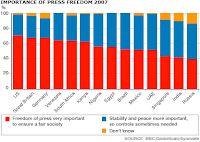 In those countries, around 48% of respondents supported controls over the press to ensure peace and stability.
Around 40% expressed the view that press freedom was more important.
People were also asked to rate how free the press and broadcasters were in their country to report the news truthfully and without undue bias.
Perceptions varied widely among developing countries, ranging from 81% giving a high rating in Kenya, to 41% in Mexico.
In India, 72% of respondents thought their media were free, compared with just 36% in Singapore.
Honesty
But some developed countries which strongly believed in press freedom were critical of their own media's honesty and accuracy.
 In the United States, Britain and Germany, only around 29% of those interviewed thought their media did a good job in reporting news accurately.
Chris Coulter, vice-president of GlobeScan, the company that led the research, says: "Despite the fact that people in Britain really value freedom of the press, when we asked specifically around news organisations how they're doing in reporting news accurately and truthfully, respondents were quite critical."
"Only about a third of people in Britain actually gave positive ratings to either publicly-funded news organisations or privately-funded news organisations."
 He says he was quite surprised by this finding, but points out that the research was conducted during October this year, when trust in the BBC and other public service broadcasters in Britain had been hit by a series of phone-in problems and other editorial lapses.
Owners' views
The survey also identified concern in some countries over the concentration of private media ownership in the hands of fewer large companies.
In Brazil, Mexico, the United States and Britain, more than 70% of respondents agreed with the suggestion that ownership was an issue because the owners' political views emerged in the news.
Germans had a particularly poor view of their private media companies - with just 18% giving them a high rating for accurate news.
 But overall, publicly-run news organisations were viewed slightly more negatively than ones run for profit.
Only in Egypt, Germany, Russia and Singapore did people rate the public media more than privately-owned media companies.
The poll was conducted by the international research firms GlobeScan and Synovate, as part of a season of programmes marking the 75th anniversary of BBC World Service.- BBC
 The combination of higher energy prices and weaker growth prospects in advanced economies could dampen the outlook also for emerging markets. Nonetheless, despite these risks, the most likely outcome is a continued global expansion.


